The Samsung Galaxy Z TriFold is one of the most exciting phones Samsung has ever revealed. It is the first Samsung device that unfolds twice, turning a normal-sized phone into a full 10-inch display. Samsung says this phone represents the future of mobile AI, foldable tech, and portable productivity. And if you’re interested in learning about what it offers, then continue reading below, as we’ve put together its specifications, release date, and price.
Samsung Galaxy Z TriFold release date confirmed
Samsung confirmed that the Galaxy Z TriFold will first launch in Korea on December 12, 2025, which matches an earlier ‘Q4’ leak. After that, the phone will roll out to other major markets, including China, Taiwan, Singapore, the UAE, and the United States. Availability for the U.S. market will start in Q1 2026.
Samsung plans to place the device in select retail stores so people can try it in person before purchasing. This makes sense because it has a unique triple-folding design that many users will want to see and experience firsthand.
Samsung is also offering early buyers some extra perks. Anyone who purchases the Galaxy Z TriFold will get a six-month trial of Google AI Pro, which gives access to advanced Gemini features and 2TB of cloud storage. Samsung will also give every buyer a one-time 50% discount on display repair, which is helpful because foldable screens are usually expensive to fix.
Samsung Galaxy Z TriFold specifications
Samsung has also shared the complete specifications of the TriFold, which you can check out below.
Deals season is here folks, and Amazon has already kickstarted its early Black Friday deals! We’ll be covering all the best deals in more details over in our deals hub, but if you haven’t got time to read through those, why not see our top picks below.
*Prices and savings subject to change. Click through to get the current prices.
| Galaxy Z TriFold | ||
| Display | Main Screen | 10.0-inch QXGA+ Dynamic AMOLED 2X (2160 x 1584), 269 ppi 1600 nits peak brightness 120 Hz adaptive refresh rate (1~120 Hz) |
| Cover Screen | 6.5-inch FHD+ Dynamic AMOLED 2X (2520 x 1080, 21:9), 422 ppi 2600 nits peak brightness 120 Hz adaptive refresh rate (1~120 Hz) | |
| Dimension & Weight | Folded (HxWxD) | 159.2 x 75.0 x 12.9 mm |
| Unfolded (HxWxD) | 159.2 x 214.1 x 3.9 mm (screen with the SIM tray) / 4.2 mm (center screen) / 4.0 mm (screen with the side button) | |
| Dimension | Approximately 3.9 mm (screen with the SIM tray), 4.2 mm (center screen), 4.0 mm (screen with side button) | |
| Weight | 309 g | |
| Rear Camera | Ultra-Wide | 12 MP Ultra-Wide Camera Dual Pixel AF, F2.2, Pixel size: 1.4 μm, FOV: 120˚ |
| Wide | 200 MP Wide-Angle Camera Quad Pixel AF, OIS, F1.7, Pixel size: 0.6 μm, FOV: 85˚ Optical Quality Zoom 2x | |
| Tele | 10 MP Telephoto Camera PDAF, OIS, F2.4, Pixel size: 1.0 μm, FOV: 36˚, 3x Optical Zoom, Digital Zoom up to 30x | |
| Front Camera | Cover Screen | 10 MP Selfie Camera F2.2, Pixel size: 1.12 μm, FOV: 85˚ |
| Main Screen | 10 MP Main Camera F2.2, Pixel size: 1.12 μm, FOV: 100˚ | |
| AP | Snapdragon 8 Elite Mobile Platform for Galaxy (3 nm) | |
| Memory & Storage | 16 GB Memory with 1 TB internal storage, 16 GB Memory with 512 GB internal storage, MicroSD not supported | |
| Battery | 5,600 mAh three-cell battery system | |
| Charging | Super-Fast Charging 2.0 (45 W) Wired Charging: Up to 50 percent charge in around 30 minutes with 45 W Adapter and 3A USB-C cable Fast Wireless Charging 2.0 (15 W) | |
| Water Resistance | IP48 | |
| Glass/Metal | Cover | Corning Gorilla Glass Ceramic 2 |
| Back | Ceramic-Glass Fiber Reinforced Polymer | |
| Frame | Titanium Hinge Housing and Advanced Armor Aluminum Frame | |
| OS | Android 16 One UI 8 | |
| Network & Connectivity | 5G, LTE, Wi-Fi 7, Bluetooth v5.4 | |
| Sensors | Capacitive fingerprint sensor (side), accelerometer, barometer, gyro sensor, geomagnetic sensor, hall sensor, proximity sensor, light sensor | |
| Security | Samsung Knox with Samsung Knox Vault | |
| SIM Card | Up to two Nano SIM and Multi eSIM | |
| Colors | Crafted Black | |
For starters, the Galaxy Z TriFold is powered by the Snapdragon 8 Elite, which is one of Qualcomm’s most powerful chips for phones, and Samsung customized it to meet the performance demands of a tri-folding device. Aside from that, it comes with 16GB of RAM and either 512GB or 1TB of storage. There is no microSD card slot, so storage isn’t expandable.
When closed, the TriFold looks like a normal premium phone with a 6.5-inch Dynamic AMOLED 2X cover screen. When you fully open it, it becomes a large 10-inch AMOLED display, which is bigger than any other Samsung phone screen ever made. Samsung kept the phone surprisingly thin, measuring only 3.9 mm at its thinnest point when unfolded.
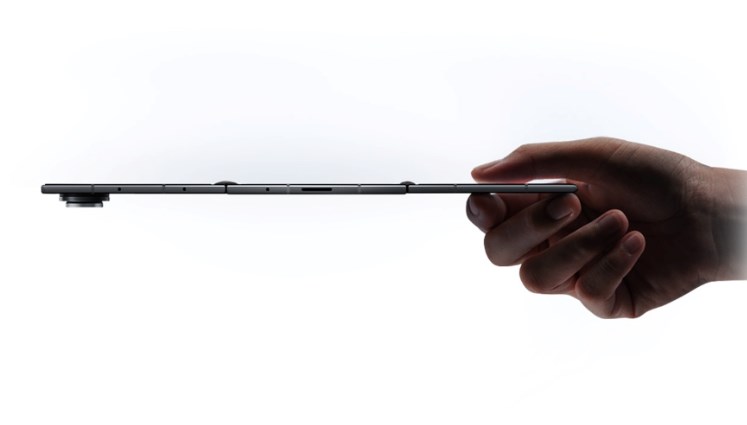
Samsung also worked on a new hinge system called Armor FlexHinge. The TriFold has two hinges of different sizes that work together smoothly. They are built to handle the stress of folding twice without causing gaps or extra bulk. The device also uses strong materials like a titanium hinge housing and an Advanced Armor Aluminum frame.
Both displays support a 120Hz refresh rate for smooth scrolling and animations. The cover screen can reach up to 2,600 nits brightness, while the main screen goes up to 1,600 nits. This means the phone stays bright outdoors, and you can even use it in well-lit environments.
Battery life also appears to be solid as the TriFold uses a three-cell system with a total size of 5,600 mAh. The battery is divided across the phone’s three panels so power can be delivered evenly. Samsung says this design helps the phone last all day, even with heavy use. It supports 45W super-fast charging, letting you reach about 50% in around 30 minutes. It also supports Fast Wireless Charging 2.0 and Wireless PowerShare, allowing you to charge other devices wirelessly.
The camera system is also high-end. The rear setup includes a 200 MP wide camera, a 12 MP ultra-wide camera, and a 10 MP telephoto camera with 3x optical zoom and up to 30x Space Zoom. On the front, there are two 10 MP selfie cameras: one on the cover screen and one inside on the main screen.
Samsung Galaxy Z TriFold price
According to Samsung, the Galaxy Z TriFold Crafted Black with 16GB of RAM and 512GB of storage will cost KRW 3,594,000 in South Korea. This translates to €2,108 or $2,450. Samsung hasn’t officially confirmed the prices for other regions, but you can expect it to be around the $2,500 mark in the United States, with the 1TB variant costing $200 or $300 more.
When does the Samsung Galaxy Z TriFold come out in the US?
While the new Galaxy Z TriFold has been given an exact date of release in the Korean market, December 12, no specific date has been given for the United States or other international markets. However, according to a Samsung press release, “Galaxy Z TriFold will be available in the U.S. in the first quarter of 2026” – more details are to follow. In short, that means anywhere between January 1 and March 31, 2026. It’s not immediately clear if the same can be said for other regions.
How many Samsung foldable phones are there?
You may know that this isn’t the only foldable phone Samsung has released this year. The Korean tech giant also released the Galaxy Z Flip 7 and Galaxy 7 Fold 7 earlier this year, the seventh generation of the brand’s foldable duo. The new TriFold model joins them for the first time. The current-gen roster includes three models in total:
- Samsung Galaxy Z TriFold
- Samsung Galaxy Z Flip 7
- Samsung Galaxy Z Fold 7